
Court marriage is a legally recognized marriage performed under the provisions of the Special Marriage Act, 1954. It allows two individuals to marry regardless of their religion, caste, or community while ensuring legal protection and official recognition. In recent years, court marriages have become increasingly popular among couples seeking a straightforward and legally secure marriage process.
One of the most important aspects of the registration process is preparing the required court marriage documents. Missing or incorrect paperwork can lead to delays, additional visits to the marriage registrar’s office, or even rejection of the application. Therefore, understanding the documentation requirements beforehand can save time and make the process smoother.
This guide explains the latest requirements for court marriage documents in India, eligibility criteria, witness requirements, verification procedures, and common mistakes to avoid during registration.
What Is a Court Marriage?
A court marriage is a marriage solemnized and registered before a Marriage Officer appointed by the government. Unlike traditional weddings that involve religious ceremonies, court marriages are conducted according to legal procedures prescribed by law.
The marriage becomes legally valid once the required formalities are completed and the marriage certificate is issued. The certificate serves as official proof of marriage and is accepted for various legal and administrative purposes such as passport applications, visa processing, bank nominations, insurance claims, and property matters.
Eligibility Criteria for Court Marriage in India
Before submitting court marriage documents, couples must ensure that they meet the legal eligibility requirements. The law specifies certain conditions that must be fulfilled for a valid marriage.
The groom must be at least 21 years old, while the bride must be at least 18 years old. Both parties must be mentally capable of giving valid consent and should not have a living spouse at the time of marriage. Additionally, the individuals should not fall within prohibited degrees of relationship unless permitted by applicable customs.
Meeting these conditions is essential because the Marriage Officer verifies both eligibility and submitted documents before approving the marriage application.
Court Marriage Documents Required in India
Preparing accurate court marriage documents is the most crucial step in the registration process. The authorities generally require identity proof, address proof, age proof, photographs, and witness-related documents.
Documents Required for Bride and Groom
The following documents are commonly required:
- Proof of age such as Birth Certificate, Class 10 Marksheet, Passport, or Aadhaar Card.
- Identity proof such as Aadhaar Card, Passport, PAN Card, or Voter ID.
- Address proof such as Aadhaar Card, Passport, Driving License, Utility Bill, or Rent Agreement.
- Recent passport-size photographs.
- Affidavit stating date of birth, marital status, nationality, and willingness to marry.
These court marriage documents help the Marriage Officer verify the identity and eligibility of both parties before proceeding with registration.
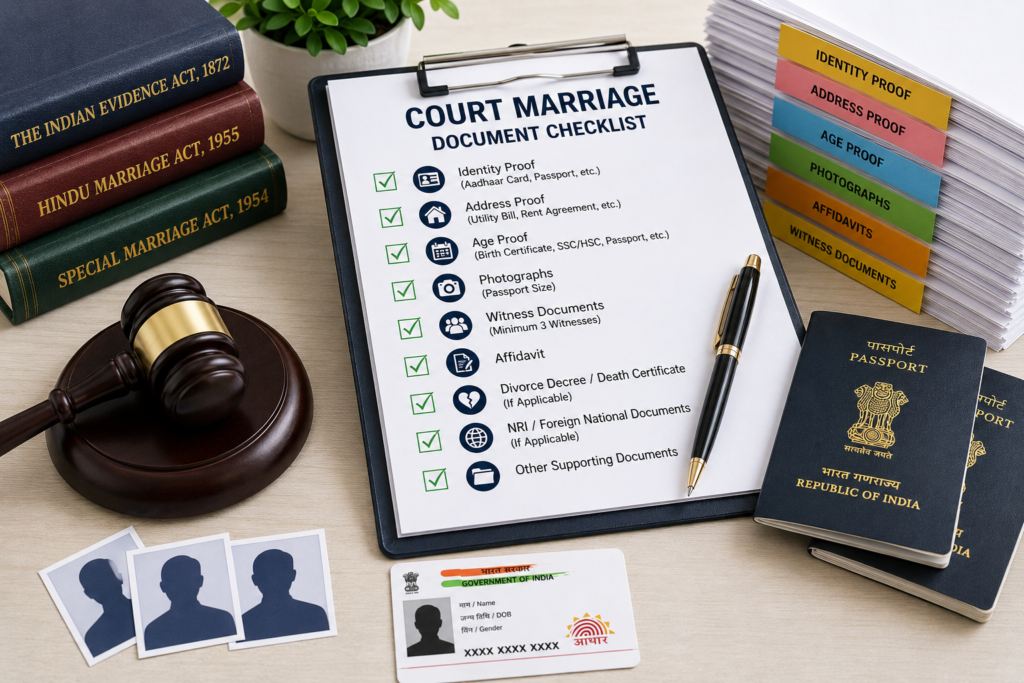
Important Court Marriage Documents and Their Purpose
| Document | Purpose |
|---|---|
| Aadhaar Card | Identity and address verification |
| Birth Certificate | Age verification |
| Class 10 Certificate | Proof of date of birth |
| Passport | Identity, age, and address proof |
| PAN Card | Additional identity proof |
| Passport-size Photos | Application and record purposes |
| Affidavit | Declaration of marital status and consent |
| Divorce Decree (if applicable) | Proof of legal divorce |
| Death Certificate of Spouse (if applicable) | Proof of widow/widower status |
| Witness ID Proof | Verification of witnesses |
Documents Required for Witnesses
Witnesses play a vital role in the court marriage process. Generally, three witnesses are required to be present at the time of marriage registration and certificate issuance.
The witnesses must be adults and should carry valid identity and address proof. Commonly accepted documents include Aadhaar Card, Passport, Voter ID Card, or Driving License. Recent passport-size photographs of witnesses may also be required in some jurisdictions.
The Marriage Officer records witness details and signatures as part of the official marriage registration process. Therefore, it is advisable to inform witnesses in advance and ensure they carry original documents on the scheduled date.
Additional Court Marriage Documents in Special Cases
Certain situations may require additional court marriage documents beyond the standard paperwork. These requirements depend on the personal circumstances of the bride and groom.
If either party is divorced, a certified copy of the final divorce decree issued by the competent court must be submitted. In cases where a previous spouse has passed away, the death certificate must be provided as evidence.
For foreign nationals marrying in India, additional documents such as a valid passport, visa, proof of residence, and a No Objection Certificate from the concerned embassy may be required. Some states may also ask for translated and notarized copies of foreign documents.
Step-by-Step Court Marriage Registration Process
Submission of Notice
The process begins with filing a notice of intended marriage before the Marriage Officer in the district where at least one party has resided for the prescribed period. The notice contains basic information about the bride and groom along with supporting court marriage documents.
The Marriage Officer records the application and displays the notice publicly as required under the Special Marriage Act.
Notice Period and Verification
After submission, a statutory notice period of 30 days is generally observed. During this period, objections may be raised if there are valid legal grounds against the marriage.
The authorities verify all submitted court marriage documents and ensure that both parties satisfy legal requirements. If no valid objection is received, the marriage may proceed.
Marriage Registration and Certificate
Once the notice period is completed, both parties and witnesses appear before the Marriage Officer. After completing the required formalities and signing the marriage register, the marriage is officially solemnized.
The Marriage Certificate is then issued, providing legal recognition of the marriage throughout India.
Common Mistakes to Avoid While Preparing Court Marriage Documents
Many applications are delayed because of avoidable errors in documentation. Couples should carefully review all paperwork before submission.
Some common mistakes include submitting expired identity documents, mismatched names across records, incorrect addresses, unclear photocopies, and incomplete affidavits. Another frequent issue is failing to bring original documents during verification.
Ensuring consistency in personal details across all court marriage documents can significantly reduce processing delays and prevent unnecessary complications during registration.

Importance of Accurate Documentation
Proper documentation serves as the foundation of a legally valid court marriage. Every document submitted helps establish identity, age, residence, marital status, and eligibility under the law.Accurate court marriage documents not only facilitate smooth registration but also help avoid future legal disputes. The marriage certificate issued after successful registration can be used for official purposes such as updating government records, obtaining visas, claiming benefits, and proving marital status whenever required.
Therefore, couples should carefully organize all documents, verify their authenticity, and keep multiple copies for future use.
Benefits of Court Marriage
Court marriage offers several advantages over traditional marriage ceremonies. It provides legal recognition irrespective of religion or caste and ensures protection under Indian law.
Additionally, court marriages are generally more economical, involve fewer formalities, and provide a legally valid marriage certificate immediately after completion of the process. For couples seeking a simple and legally secure marriage, court marriage remains a practical option.
The process also promotes equality and personal choice by allowing individuals to marry based on mutual consent rather than religious or social considerations.
FAQs
What are the essential court marriage documents required in India?
The essential court marriage documents include age proof, identity proof, address proof, passport-size photographs, and an affidavit declaring marital status and consent. Additional documents may be required in special circumstances such as divorce or widowhood.
How many witnesses are required for court marriage?
Generally, three adult witnesses are required during the registration process. They must carry valid identity and address proof and be present before the Marriage Officer on the scheduled date.
Is Aadhaar Card mandatory for court marriage?
Aadhaar Card is commonly accepted as identity and address proof, but other government-issued documents such as Passport, Voter ID, or Driving License may also be accepted depending on local requirements.
Can divorced individuals apply for court marriage?
Yes, divorced individuals can apply for court marriage. However, they must submit a certified copy of the final divorce decree issued by the competent court along with other required documents.
How long does the court marriage process take?
Under the Special Marriage Act, the process generally takes at least 30 days due to the mandatory notice period. The exact timeline may vary depending on document verification and administrative procedures.
What happens if court marriage documents contain errors?
Errors in submitted documents can lead to delays, additional verification, or rejection of the application. It is advisable to review all details carefully before submission and ensure consistency across all records.
Conclusion
Understanding the required court marriage documents is essential for a smooth and hassle-free marriage registration process in India. Proper preparation of identity proofs, address proofs, age proofs, affidavits, and witness documents helps avoid delays and ensures compliance with legal requirements. Whether the couple belongs to the same religion or different communities, court marriage offers a legally recognized and secure way to formalize their relationship.
By collecting all necessary court marriage documents in advance, verifying their accuracy, and following the prescribed procedure, couples can complete their marriage registration efficiently and obtain a valid marriage certificate with confidence.
Read More:-Court Marriage Process in India: Quick Guide